
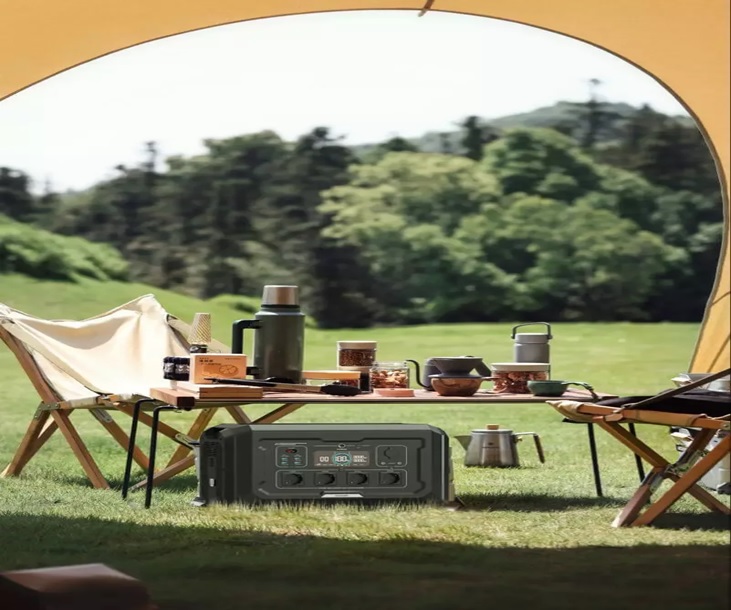

A few miles beyond the last cell tower is where a hiker can experience a different kind of peace. With no traffic or texts to be concerned with, all they hear is the rustling of the leaves and perhaps a crackling fire. In order to experience this, one would have to venture beyond their normal haunts. It is also in order to reach these areas that we offer Portable Power Stations for Camping . These units can give the camper a sense of serenity while assuring that their electrically powered essentials and conveniences are either charged or ready to go. Just wait until your battery reaches ten percent before you need to turn your phone on to get directions or call for help. It’s a nice escape that can turn into an unwanted predicament.
A Portable Power Station for Camping can also be used for the essential devices such as lights, a CPAP machine, or to run a mini fridge, as well as some legal devices that will replicate many of the functions of a gas generator without the drawback of emissions. For those adventurers that want to leave the hustle and bustle of the modern world behind, this one item can totally transform their camping experiences and, in some cases, far exceed their expectations.
The Problem With “Just Bring Extra Batteries”
Most new campers attempt to solve the power dilemma by bringing along a couple power banks and packs of AA batteries or maybe even a solar charger clipped to their backpack. Maybe that would be sufficient for a weekend excursion on a mostly sunny day with limited phone usage, but the problems start when trips become longer and busier, or when the gear necessary becomes more power hungry. One power bank can run approximately 10,000 to 20,000 mAh. Seems like a lot until you factor in that a phone battery is on average 3,000 mAh and you’re not just running your phone. Factor in the camera, the speaker, the headlamp, the satellite communicator to boot. Perhaps even the small air pump for the camping mattress that goes along with your car camping setup and a cooler. The added weight of these batteries can prove to be a burden especially when one inevitably needs to use their phone as a makeshift flashlight or GPS.
What Changes When You Bring Real Power Capacity
This is where a good quality power station comes into its own. Instead of a bunch of different smaller devices with batteries that run out every few hours, a good power station should have enough capacity to power multiple devices for multiple days. The ones we found that were the best camping power stations had a minimum capacity of around 300 watt hours, and up to over 1,000, and have multiple outputs, from USB-A to USB-C to 12V and even AC outlets. This lets you keep your devices, ranging from phones to lanterns to camping fridges all powered at the same time.
This also opens up the possibility of running medical equipment, if a member of your party has an emergency, or a satellite phone, if the weather is too bad to use a regular cellphone, so you can still call for help if needed. Unlike a gas generator, a power station is completely silent, and doesn’t emit any noxious fumes, so they are much safer to use, even inside your tent or camper van if you’re camping.
Solar Charging Makes It a Long-Term Solution
The other major appeal, and one that many will discover upon purchase, is solar compatibility. As most portable power stations are sold with foldable solar panels, on-the-go recharging becomes a breeze. Whether you’re hiking through the wilderness, fishing by the lake, or simply practicing van life during a multi-day road trip, having the option to recharge your devices in camp and away from traditional power sources is incredibly convenient and allows for a more versatile power plan in situations where you have no access to electricity at all. Solar power alone is often unreliable if you’re camping in a region with overcast skies, but paired with a portable battery’s stored energy, you can keep your gear powered for days. Even only 3-4 hours of sun can make the difference between your phone battery lasting until morning or dying before you reach camp when you’re out on a 5-day backpacking expedition.
Weight, Size, and Picking the Right Capacity
Not all excursions are the same, so it is not surprising that most have different requirements. That is why the same goods can have a significantly different price range – from low to high. A backpacker who went on a solo 7-day backpacking adventure has different energy needs than a family of four who spent a week driving to a campsite. Thus, light tourists only need a battery with a power of 100-300 Wh in a suitcase to keep their devices charged during hiking. At the same time, the camping family may want to choose a more powerful station (or several batteries) with a power of 500-1000 Wh to be able to use all the comforts of their tent.
Besides, it is essential to check what power outputs the station will have. Lower priced models often lack a sine-wave output needed to operate some delicate electronics or medical equipment.
Real Situations Where It Makes a Difference
Camping Power is the brand behind the power station that provides families with the electricity they need to stay connected and charged up while on the trails. It’s easy to think about the specs, but being able to imagine the real-world scenario helps to bring it to life. For example, a family that goes camping on the weekends may want to charge their devices during the rain on day two for the storm that is forecasted. The tarp over their tent may keep the storm out, but it’s the camping power power station that keeps their flashlight lit, and their phones charged up for updated weather reports. For those that are van-living or over-landing, it can be an essential part of the build as it powers the fridge, the air fryer, and the laptop for those working remotely from the road every day, until they can find the campsite with shore power.
In either case, the camping power power station is the one that keeps them connected, powered up, and ready for whatever the trail throws their way. In these situations, it’s not an accessory to the vehicle, but rather part of its electrical system, and a Camping Power Station makes it possible to live off-grid for days, or even weeks at a time.
A Small Investment That Changes How You Camp
All this for a campsite apartment? Not exactly, because that’s the sort of equation that’s better erased from your calculations entirely – the one where your dead phone battery, the dark tent interior and the realization that you have just wrecked the whole point of this exercise are neatly folded into one wretched moment, one unhappy swipe and a thousand pixels of white.
For those who camp more than twice a year, the answer is simple: power station purchase calculus will deliver far better ROI than any tent purchase, and it will do so over twelve cycles, quietly taking away all manner of worries. After all, next time you wake up on a cloudy morning or get caught in an unexpectedly long expedition without one, it will be very hard to return to the wilderness without it.